KOSPI Closes 3.3% Higher as Japan and Nasdaq Futures Fade from Early Highs
Last saved:
Executive Summary
- ✦The KOSPI closed 3.29% higher as Samsung and SK hynix each gained nearly 6%.
- ✦The rebound still left the KOSPI below Monday’s 5,768.01 close.
- ✦The Nikkei and Nasdaq futures gave back a large part of their early gains while Greater China traded lower.
- ✦A close above 5,768.01 would strengthen the repair; a return below 5,552.74 would weaken it.
KOSPI Closes 3.3% Higher as Japan and Nasdaq Futures Fade from Early Highs
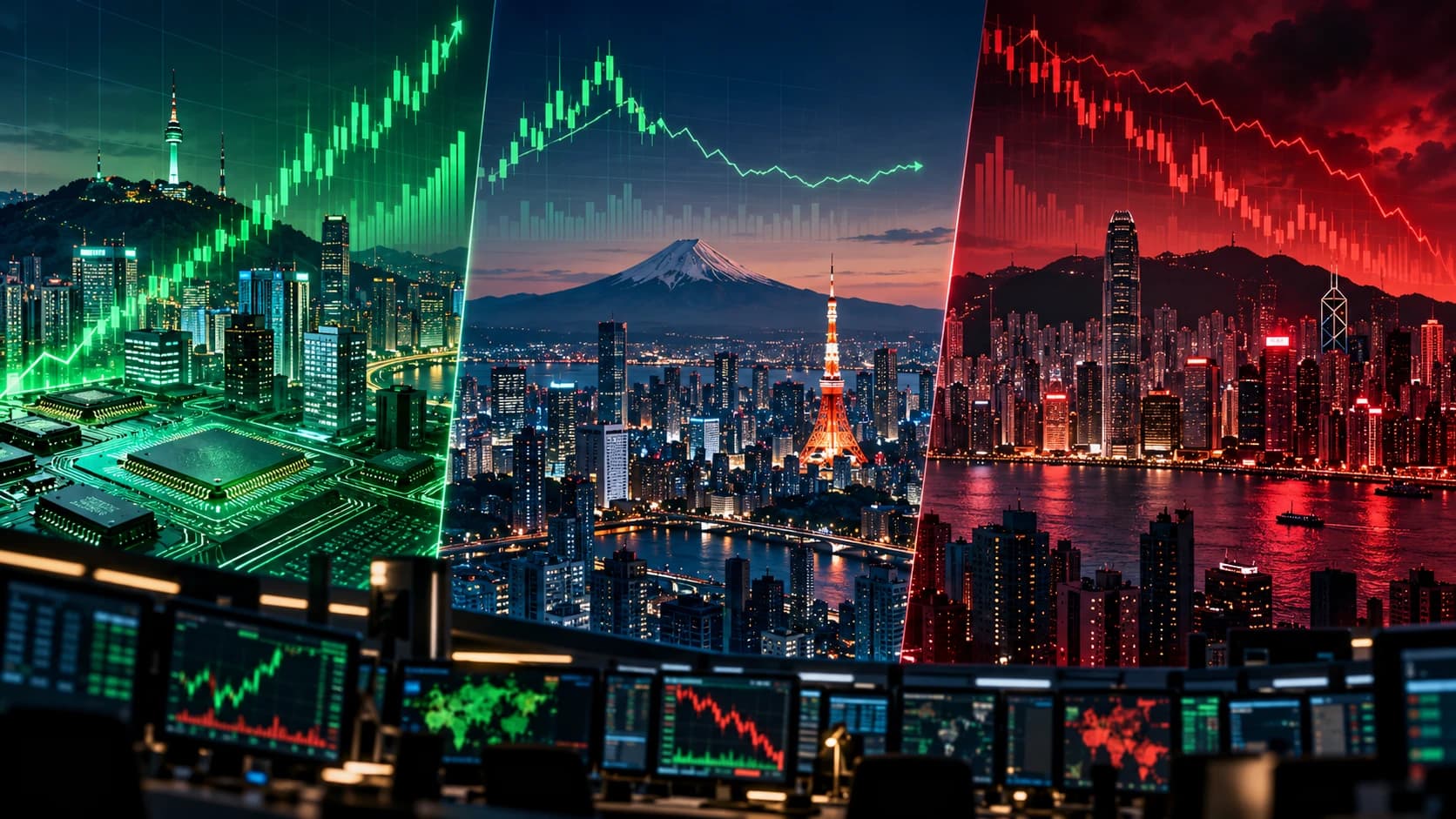
South Korea preserved most of its technology-led rebound into Wednesday's close, but the wider Asian signal weakened as Japan gave back more than half of its early gain, Greater China traded lower and Nasdaq-100 futures retreated from their overnight high. The result confirms strong bargain buying in Korean chip shares without confirming a broad regional risk-on turn.
বাংলায় পড়ুন: KOSPI 3.3% Higher Close, Japan ও Nasdaq Futures Early High থেকে Fade
Timeframe: 21 October 2026, approximately 13:02 Bangladesh / 07:02 UTC. South Korea and Japan figures are cash-market closes. Hong Kong and Shanghai are live or delayed afternoon observations from 06:46–06:47 UTC. US index futures, commodity futures and Bitcoin are live or delayed observations from 06:51–07:02 UTC. Open-market prices can change after publication.
Korea held the rebound into the close
| South Korea | Close | Previous close | Move |
|---|---|---|---|
| KOSPI | 5,735.66 | 5,552.74 | +3.29% |
| Samsung Electronics | ₩223,500 | ₩211,500 | +5.67% |
| SK hynix | ₩1,294,000 | ₩1,223,000 | +5.81% |
AP reported that the KOSPI closed 3.3% higher at 5,735.66. It also noted that Elice, whose 32% first-day fall had unsettled the Korean market on Tuesday, rebounded to its 29.9% daily upper limit.
Samsung and SK hynix both retained gains of almost 6%. That matters because the early rally was heavily concentrated in these two semiconductor leaders. Their closing strength confirms that the opening move was not completely sold into the close.
The KOSPI nevertheless remains below Monday's 5,768.01 close. Tuesday's 3.73% fall to 5,552.74 was not fully recovered. Wednesday therefore repaired most of one down day but did not yet restore the previous level.
The opening surge lost some force
The early-session Money Man analysis recorded:
- KOSPI up about 3.74%; it closed up 3.29%.
- Nikkei 225 up about 1.83%; it closed up about 0.85%.
- SK hynix up about 7.69%; it closed up 5.81%.
- Nasdaq-100 futures up about 0.99%; they were up about 0.52% at 06:52 UTC.
Korea held most of its advance, while Japan and US technology futures lost a larger share of theirs. This is still positive price action, but the close is less powerful than the opening snapshot.
Japan's trade data gave a mixed macro signal
| Japan | Close | Previous close | Move |
|---|---|---|---|
| Nikkei 225 | 64,621.24 | 64,075.42 | +0.85% |
| SoftBank Group | ¥4,622 | ¥4,554 | +1.49% |
AP reported that Japan's September exports rose 16.7% year on year, supported by autos and computer-related components. Imports climbed 18.9%, largely because of higher oil prices, and the trade deficit almost doubled from a year earlier.
The export growth supports the technology and manufacturing outlook. The import rise shows the cost: high energy prices are worsening Japan's trade bill. That helps explain why a strong opening did not become an equally strong close. The data support exporters while keeping pressure on margins, inflation and household purchasing power.
Greater China moved the other way
| Afternoon market | Latest observed | Previous-session close | Approximate move |
|---|---|---|---|
| Hang Seng | 23,693 | 23,867.74 | −0.73% |
| Shanghai Composite | 3,706.42 | 3,735.37 | −0.78% |
Hong Kong and Shanghai were lower while Seoul and Tokyo finished higher. No single fresh catalyst was verified for the late Greater China decline, so the price divergence should not be assigned an invented cause.
The practical implication is clear: the AI earnings rebound did not create a uniform Asia-wide bid. Korea's semiconductor sensitivity amplified the positive catalyst, while mainland and Hong Kong markets continued to trade on a different mix of domestic growth, policy and sector factors.
US futures retained gains but narrowed the signal
| US futures | Latest observed | Previous settlement | Move |
|---|---|---|---|
| December Nasdaq-100 | 29,828.75 | 29,675.25 | +0.52% |
| December S&P 500 | 7,770.50 | 7,755.25 | +0.20% |
| December Dow | 52,736 | 52,719 | +0.03% |
Nasdaq futures were still leading, consistent with the technology earnings catalyst. The lead had narrowed from almost 1% earlier in Asia.
This is an incomplete confirmation signal. The futures market still points higher, but the cash session must show whether semiconductor, software and infrastructure shares participate beyond the initial after-hours response. Meta, Tesla and IBM earnings are among the next tests.
Oil is the cross-asset constraint
| Asset | Latest observed | Reference | Move |
|---|---|---|---|
| Brent futures | $110.40/bbl | $108.79 settlement | +1.48% |
| December WTI futures | $99.24/bbl | $97.82 settlement | +1.45% |
| December gold futures | $4,130.20/oz | $4,142.60 settlement | −0.30% |
| Bitcoin | $82,740 | $82,940 daily reference | −0.24% |
| US Dollar Index | 101.79 | 101.70 reference | +0.09% |
Oil strengthened as the Asian equity rally faded. Brent above $110 matters for Japan's import bill and for global inflation expectations. If oil extends higher, bond yields and valuation pressure could challenge the technology rebound even if company earnings remain strong.
Gold and Bitcoin were slightly lower. That supports the view that this was a concentrated equity-sector rebound rather than a broad cross-asset surge in risk appetite.
Daily-timeframe scenarios
Bullish continuation
The Korean rebound gains credibility if the KOSPI closes above 5,768.01, Samsung and SK hynix continue to participate, and Nasdaq-100 futures convert their gain into a strong US cash close. Broader gains in Japan and Greater China would improve regional breadth.
Consolidation
The KOSPI can trade between 5,552.74 and 5,768.01 while markets digest Tuesday's sell-off and Wednesday's rebound. A range would keep the repair intact without proving a new daily uptrend.
Failed rebound
The view weakens if the KOSPI closes back below 5,552.74, chip shares give up Wednesday's gains and Nasdaq-100 futures lose the 29,675.25 previous settlement. A further oil rise or renewed Treasury-yield increase would strengthen the bearish case.
The Money Man View
Korea delivered a credible closing rebound. A 3.29% KOSPI gain with Samsung and SK hynix each up nearly 6% is stronger evidence than an opening gap alone.
The wider message is more cautious. The KOSPI did not reclaim Monday's close, the Nikkei surrendered more than half of its early gain, Greater China traded lower and Nasdaq futures narrowed their advance. We therefore read Wednesday as a strong Korean relief rally with partial global confirmation—not yet a broad daily-trend reversal.
The view would improve on a KOSPI close above 5,768.01 with wider participation. It would be invalidated by a close back below 5,552.74 accompanied by renewed semiconductor weakness.
What traders and investors should watch next
- Whether the KOSPI can reclaim 5,768.01 on a daily close.
- Follow-through from Samsung Electronics and SK hynix after near-6% gains.
- Nasdaq-100 futures around the 29,675.25 previous settlement.
- The US cash-session response from semiconductors and AI infrastructure.
- Meta, Tesla and IBM earnings and capital-spending guidance.
- Brent above $110 and its effect on yields, Japan's trade balance and growth valuations.
- Whether Hang Seng and Shanghai stabilise or widen the regional divergence.
Educational risk disclosure
This analysis was prepared with AI-assisted research and writing under The Money Man editorial workflow. It uses time-stamped closing, live and delayed observations that may change after publication. It is educational market analysis, not personalised investment advice or a recommendation to buy or sell any security, index future, commodity or cryptocurrency. Relief rallies can reverse, futures may differ from the cash open and leveraged losses can exceed the amount initially deposited.