RSI and Momentum Divergence: Warning Signal, Not Reversal Guarantee
Last saved:
Executive Summary
- ✦RSI measures momentum for one chosen timeframe and lookback.
- ✦Match confirmed price and oscillator pivots consistently.
- ✦Divergence warns of changing momentum but does not time reversal.
- ✦Require price confirmation and structural invalidation.
RSI and Momentum Divergence: Warning Signal, Not Reversal Guarantee
Learning objective: understand what RSI measures, identify divergence consistently and require price confirmation before acting on a momentum warning.
The Relative Strength Index compares the size of recent gains with recent losses and scales the result between zero and 100. It measures momentum in the chosen price series and lookback. It does not show whether an asset is fundamentally cheap or expensive.
1. Define the RSI settings
The common setting is 14 periods, but “period” depends on the chart. A 14-day RSI and a 14-hour RSI answer different questions. The result also depends on the data feed and price input.
Traditional labels call readings above 70 overbought and below 30 oversold. Strong trends can remain in those zones for a long time. A threshold is a condition, not an automatic order.
2. Identify divergence with fixed rules
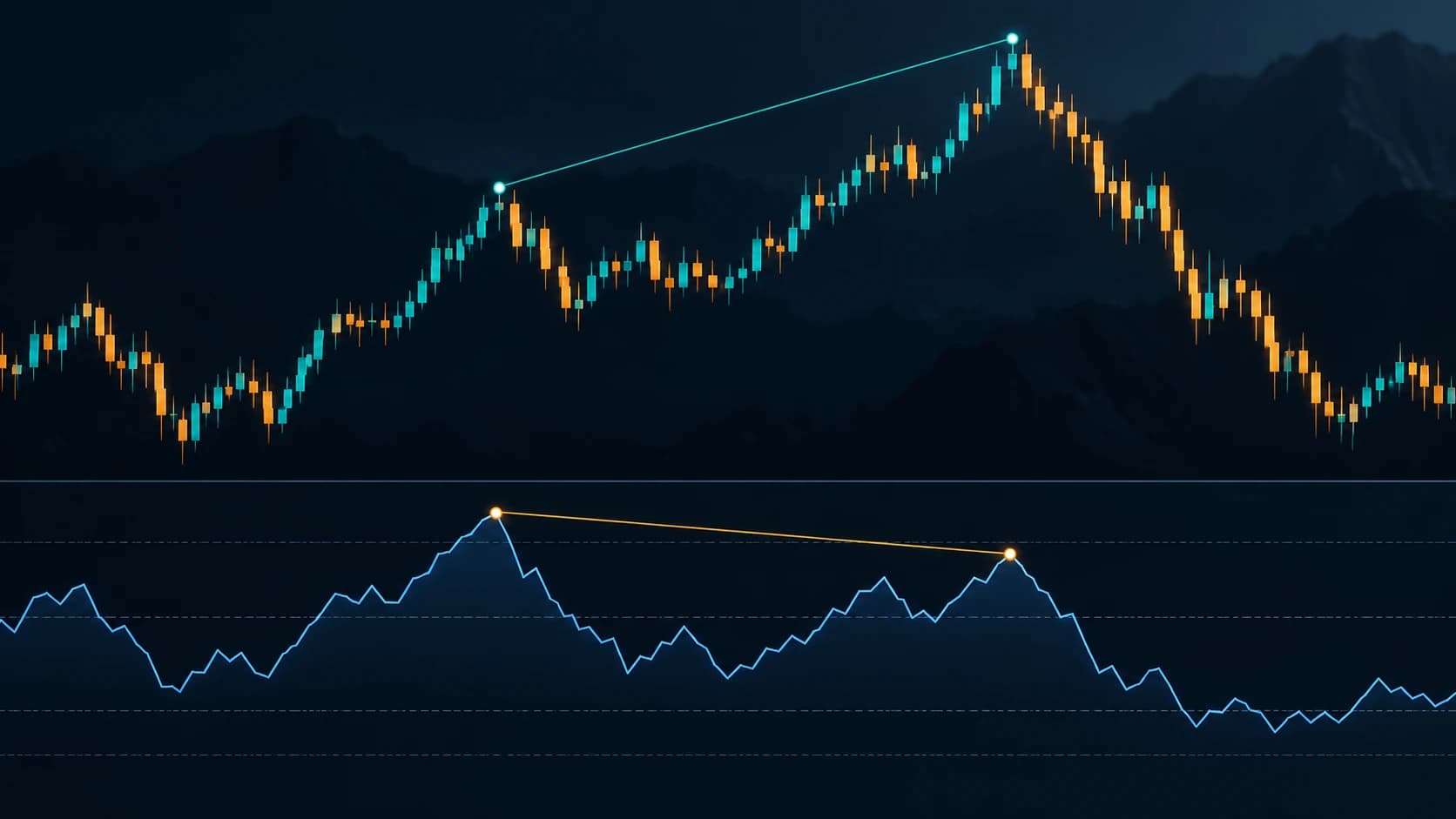
Bearish divergence occurs when price makes a higher swing high while RSI makes a lower corresponding high. Bullish divergence occurs when price makes a lower swing low while RSI makes a higher corresponding low.
Use confirmed price pivots and compare matching points. Redrawing the pivots after the outcome makes the signal impossible to test.
3. Understand what divergence means
Divergence says momentum changed relative to an earlier swing. It does not say when price will reverse. In a persistent trend, several divergences can appear before price turns, or price may simply consolidate and continue.
Hidden divergence is sometimes used to describe trend continuation, but definitions vary. Record the exact rule before testing it.
4. Require price confirmation
Possible confirmation includes a break of a swing level, failure to hold a breakout, a reversal close or a change in daily structure. The stop should come from price invalidation, not from the oscillator level.
Worked example
A hypothetical share makes a daily high at £96 with RSI at 76. After a pullback, it reaches £100, while RSI peaks at 68. This is bearish divergence under the defined pivot rule, but price is still in an uptrend.
The trader waits for a daily close below the intervening swing low at £92. Price instead consolidates above £94 and later breaks £101. No short trade is taken because the price-confirmation condition never occurs.
In another scenario, price closes at £91.50 after the divergence. A possible short setup uses £100.50 as structural invalidation. The £9 distance requires a much smaller position than a tight oscillator-based stop. The setup can still fail or gap above invalidation.
Common mistakes
- Selling solely because RSI is above 70.
- Buying solely because RSI is below 30.
- Connecting price and RSI pivots that occurred at different times.
- Calling every oscillator wiggle divergence.
- Ignoring the higher-timeframe trend.
- Moving the pivots after seeing the reversal.
- Using RSI as the stop level instead of price structure.
Practical checklist
- What timeframe, lookback and price input are used?
- Are the price pivots confirmed and matched to RSI pivots?
- Is the signal regular or hidden divergence under a written definition?
- What does the higher-timeframe trend show?
- Which price event confirms the setup?
- Where does price invalidate it?
- Is the stop distance compatible with the risk budget?
- Has the rule been tested through trending and ranging regimes?
The Money Man view
For daily-timeframe traders, RSI divergence is a useful alert that momentum and price are no longer advancing together. Price must still confirm the change. The analysis is invalid if an oscillator threshold becomes a prediction or if pivots are selected only after the outcome is known.
This tutorial is educational information prepared with AI-assisted research and writing. It is not personalised financial advice or a trade recommendation. Momentum signals can remain early or fail completely.