US Expands Prince Group Scam Sanctions: Banking and Crypto Risk Map
Last saved:
At a glance
- On 5 November, US Treasury sanctioned four individuals and 41 entities supporting the Prince Group network, plus a separate Malaysian individual linked by Treasury to an Africa-based scam operation.
- The action blocks covered property under US jurisdiction and extends to entities owned 50% or more by blocked persons; it is not proof that every payment delay is an asset loss or system failure.
- FATF's same-day report says scam compounds use payment services, virtual assets and corporate structures across borders, raising screening and beneficial-ownership risk.
- Investors should monitor official SDN updates, named-institution disclosures and verified restrictions rather than infer sector-wide damage from the sanctions alone.
Prices and market observations refer to the times stated in the article, not live quotes. Check the sources and observation times alongside the figures. Article and save dates are not quote timestamps.
The United States has expanded sanctions around the Prince Group network, moving the financial risk beyond a single named organisation and towards the corporate, payment and digital-asset infrastructure that can support cross-border scams. For traders and investors, the immediate question is not whether every bank or crypto platform is compromised. It is how sanctions screening, beneficial-ownership checks and transaction controls may affect specific counterparties and transfers.
This analysis separates a designation from an operational outage, an asset freeze from an asset loss, and an allegation by an authority from an independently proven fact.
What happened on 5 November
In a 5 November 2026 release, the US Treasury said the Office of Foreign Assets Control (OFAC) sanctioned four individuals and 41 entities that support the Prince Group transnational criminal organisation network. Treasury said the targets include companies and facilitators used for corporate administration, nominee ownership, investment, financial services and digital-asset activity.
In the same release, Treasury announced a separate designation of Malaysian individual Chui Kok Wa. Treasury alleges that he led scammers based in Africa, including Madagascar, who defrauded US victims. The department said the reported US-victim losses linked to that operation exceeded the equivalent of $400,000, including digital assets.
These are US government findings and allegations supporting sanctions. They are not a court judgment by this publication, and the designation of a support or owned entity does not mean every employee, customer or transaction connected with it committed fraud.
What the sanctions legally change
According to Treasury, property and interests in property of designated persons that are in the United States or in the possession or control of US persons are blocked and must be reported to OFAC. The restrictions also generally cover an entity owned, directly or indirectly, 50% or more by one or more blocked persons, even if that entity is not separately named.
US persons are generally prohibited from transacting with blocked property unless an exemption or OFAC authorisation applies. Treasury also warns that violations can attract civil or criminal penalties and that civil enforcement may apply on a strict-liability basis.
That creates a practical transmission channel. A bank, payment processor, exchange or corporate-service provider may pause a transfer while it checks names, ownership and wallet exposure. A compliance hold is not automatically evidence that money has disappeared, that a platform is insolvent or that a payment network has failed.
Why FATF's same-day report matters
The Financial Action Task Force report released on 5 November maps how scam compounds can use payment services, virtual assets, telecommunications, technology providers and legal entities across several jurisdictions. FATF says losses from scam activity amount to tens of billions of dollars each year globally.
FATF's report is broader than the Prince Group action, but the timing highlights the same structural problem: a scam operation can depend on ordinary-looking companies, accounts and service relationships. A simple name match may therefore be inadequate. Institutions need to understand who ultimately owns a counterparty, what economic purpose a payment serves and whether transaction patterns are consistent with the stated business.
The economic transmission map
Banks and correspondent payments
Banks exposed to US-dollar clearing or US counterparties may intensify sanctions screening and beneficial-ownership reviews. That can increase false positives, document requests and settlement delays. The direct economic cost may include additional compliance staff, legal review and rejected transactions. A larger balance-sheet effect would require verified evidence of blocked assets, fraud losses, penalties or material counterparty exposure.
Correspondent banking adds another layer. A transfer between two non-US parties can still face review if it touches a US bank or US jurisdiction. Investors should distinguish a temporary compliance review from a broad withdrawal restriction.
Crypto exchanges and digital-asset transfers
Treasury explicitly describes digital-asset transactions as part of the networks it targeted. Exchanges and custodians may respond by screening customers, wallets and withdrawal destinations more closely. A specific transfer can be delayed or frozen while ownership and transaction history are investigated.
That does not prove that Bitcoin, Ethereum or another blockchain has stopped working. Nor does a frozen withdrawal by itself establish that customer assets were stolen. The useful evidence is a named platform notice, a traceable sanctions connection, an on-chain movement confirmed by reliable analysis, or an official enforcement update.
Corporate-services and listed-company exposure
Nominee directors, offshore vehicles and administration providers can obscure control. Banks and auditors may consequently ask for more ownership evidence from companies with similar counterparties or jurisdictions. For listed companies, a market-relevant conclusion requires company-specific facts: named exposure, impaired assets, a disrupted supplier, a regulatory filing or a measurable compliance cost.
The sanctions alone do not justify treating every Asian bank, fintech, casino, property company or crypto firm as exposed.
Victims and recovery expectations
Sanctions can disrupt access to the financial infrastructure used by alleged scam networks, but they do not guarantee victim repayment. Blocking property preserves it from prohibited movement under the relevant jurisdiction; recovery and distribution require separate legal processes. Anyone claiming that a new fee can “unlock” funds should be treated with particular caution.
What remains unknown
The public releases reviewed here do not establish how much property has actually been blocked under the new designations, which banks or exchanges are reviewing transfers, or whether any listed company has a material exposure. They also do not provide a complete wallet list or quantify the network's current transaction volume.
Attribution needs care. Treasury identifies the people and entities it designated and explains the statutory basis for its action. That is different from independent proof that every alleged operator, affiliate and transaction played the same role. Further court filings, regulator notices or company disclosures may refine the scope.
The Money Man View
Analysis horizon: the next one to four weeks. Our base case is targeted compliance friction rather than a system-wide freeze. Banks, exchanges and professional-service firms with relevant names, ownership links or transaction paths are likely to review customers and transfers. Some payments may take longer while the 50% ownership rule and beneficial ownership are checked.
The adverse scenario is a new official list of wallets or entities, a named bank or exchange confirming material blocked exposure, or coordinated enforcement that interrupts a wider payment chain. That would raise the probability of platform-specific liquidity pressure, legal costs and reputational damage.
The constructive scenario is that coordinated screening isolates the designated network without materially disrupting unrelated customers or core payment infrastructure. Clear notices and prompt release of false positives would limit confidence damage.
This view would be invalidated by an official correction, delisting or authoritative evidence that the ownership and transaction links are materially different from those described. It should be escalated only when a named institution, regulator or court document confirms broader exposure—not on an unverified social-media claim.
What investors should monitor next
- updates to OFAC's Specially Designated Nationals and Blocked Persons list and any published identifiers;
- official notices from named banks, payment firms, exchanges or corporate-service providers;
- enforcement or asset-recovery updates from the FBI, US Department of Justice, British Virgin Islands authorities and the UK government;
- evidence that a restriction affects one customer or counterparty rather than an entire payment rail;
- FATF member implementation, especially beneficial-ownership and virtual-asset supervision; and
- audited losses, blocked-asset values and regulatory filings rather than estimates repeated on social media.
The practical rule is simple: verify the institution, scope, jurisdiction and asset status before drawing a market conclusion. Our payment-API cyber-risk analysis explains the separate distinction between a security intrusion, a transaction pause and insolvency.
Sources
- US Treasury: Treasury Targets Global Scam Networks and the Corporate Infrastructure That Enables Them, 5 November 2026.
- FATF: Combating illicit financial flows linked to scam compounds, 5 November 2026.
- OFAC press-release index, checked 6 November 2026.
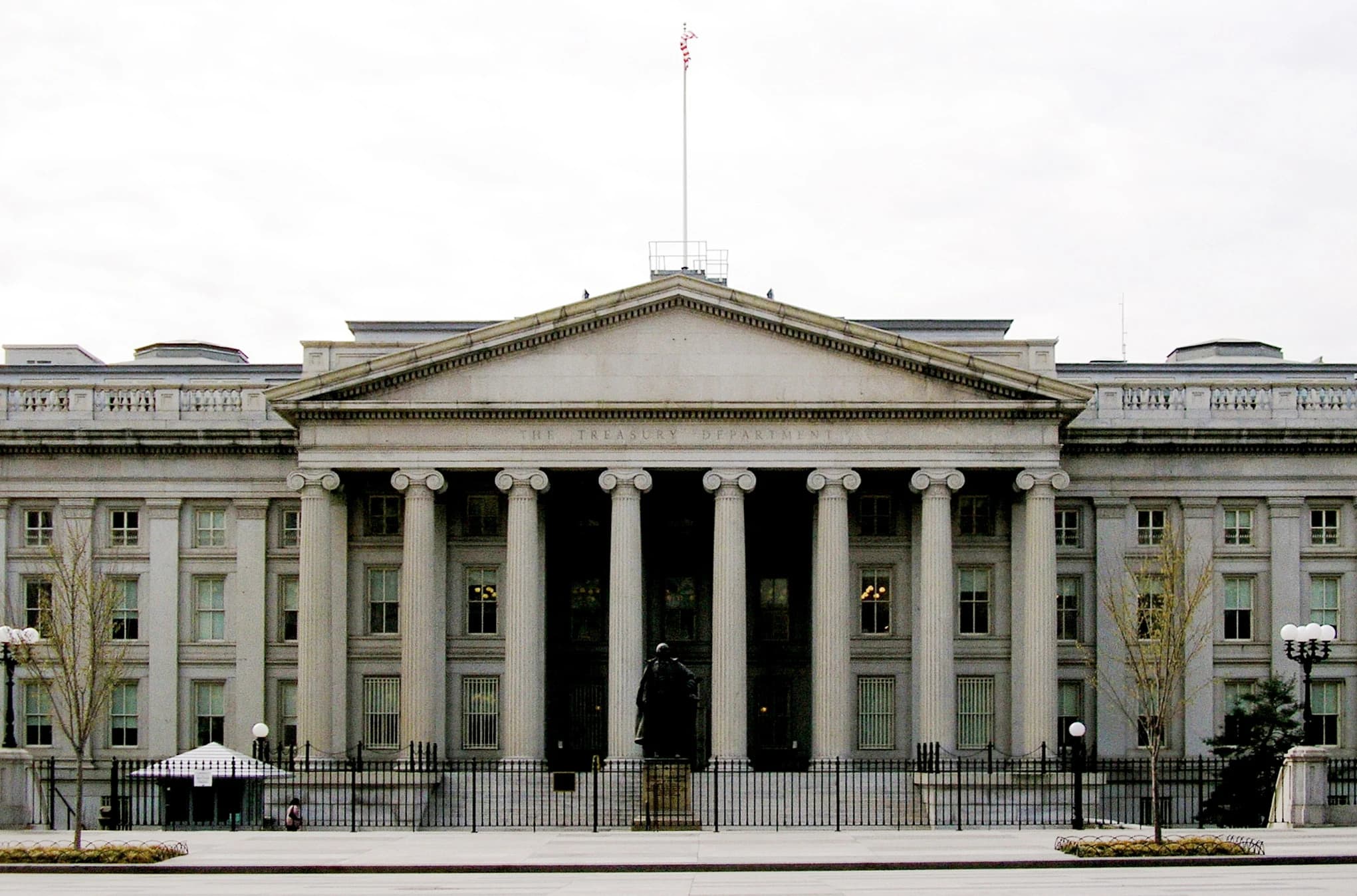
Cover image: the US Treasury Department Building in Washington, DC, photographed by Loren on 27 March 2007. Source: Wikimedia Commons. The copyright holder released the image into the public domain. The building photograph is illustrative and does not depict any designated person or entity.
This article is educational market analysis, not personalised financial, legal or sanctions-compliance advice. The Money Man combines experienced-trader perspective with AI-assisted research and writing. Verify restrictions and counterparties with the relevant authority or a qualified adviser before acting.