US Targets Iran's False-Flag Shipping Network: Oil and Insurance Risks
Last saved:
At a glance
- OFAC sanctioned an India-based network on 4 November over alleged false flags and certificates for vessels transporting sanctioned Iranian petroleum.
- The action blocks covered property and raises compliance risk; it does not prove that Iranian export volumes have already fallen.
- The clearest transmission channels are port access, P&I insurance, trade finance, cargo delays and compliant-tanker freight.
- Watch verified service denials, detentions and export volumes; stable flows would weaken a near-term oil-tightening thesis.
Prices and market observations refer to the times stated in the article, not live quotes. Check the sources and observation times alongside the figures. Article and save dates are not quote timestamps.
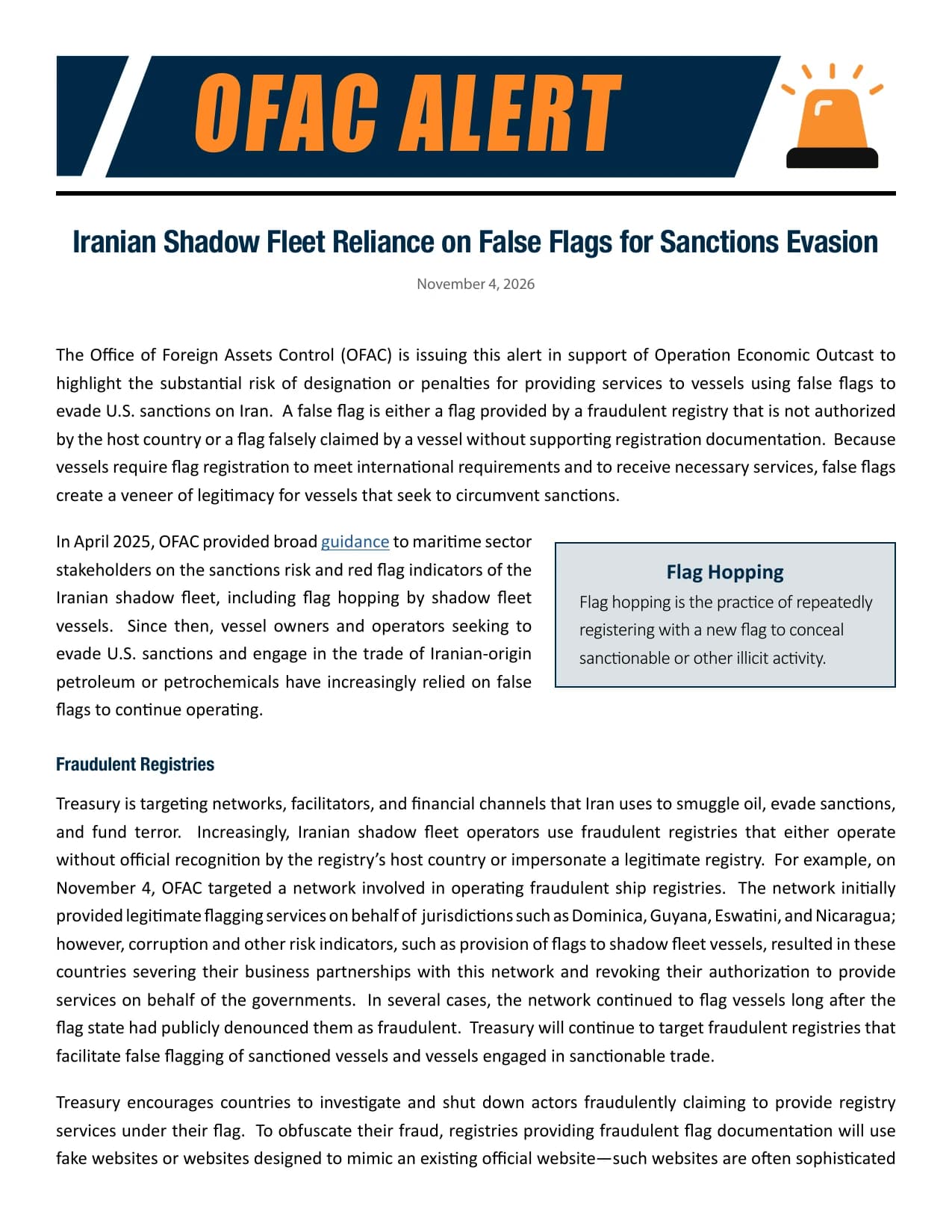
The United States has targeted a network it says supplied fraudulent flags and certificates to vessels carrying sanctioned Iranian petroleum. For traders and investors, the important question is not whether a designation sounds severe; it is whether ports, insurers, banks and charterers actually withdraw services and constrain physical oil flows.
Cover: US Treasury Office of Foreign Assets Control alert dated 4 November 2026. Public-domain US government work; reproduced for identification and reporting.
What is confirmed
On 4 November 2026, the US Treasury Department announced sanctions against an India-based network led, according to Treasury, by Suniel Kumar Sharma and Jaspreet Preeti Shahid. Treasury alleges that the network created or operated fraudulent ship registries and supplied false flags and maritime certificates to sanctioned vessels transporting Iranian petroleum, including vessels linked to Iran's military and proxies.
The action designated named individuals and businesses connected to the alleged registry network. Treasury separately designated Türkiye-based Fugo Ground Services for services it says were provided to sanctioned Iranian airlines. Reuters reporting independently corroborated the announcement and the central allegation; it did not independently prove every underlying US government claim.
The associated OFAC alert defines a false flag as one supplied by an unauthorised registry or claimed by a vessel without supporting registration. It tells insurers, trade-finance providers and other maritime businesses to apply enhanced due diligence when flags, registration papers, country codes or maritime databases conflict.
Under OFAC's description of the legal effect, property and interests in property of designated persons that are in the United States or controlled by US persons are blocked and must be reported. Entities owned 50% or more, directly or indirectly, by blocked persons are also blocked. Transactions involving blocked property are generally prohibited for US persons unless authorised or exempt. This is a sanctions action, not a court judgment about every allegation.
What is not yet confirmed
The announcement does not establish how many barrels will be delayed or removed from the market. It does not prove that every vessel using a questioned flag carries Iranian oil, that every cargo will be seized, or that all counterparties will immediately stop service. It also does not show that Iran's total exports have fallen since the designation.
False registration is broader than this one sanctions case. In May, the International Maritime Organization said its Legal Committee had noted 529 ships falsely flying a country's flag during the previous year. That figure covers the global registration problem; it should not be misrepresented as 529 Iranian or sanctioned tankers.
How the economic transmission can work
1. Service denial can matter before a ship is detained
A tanker needs more than a flag on paper. Ports, pilots, terminals, bunker suppliers, classification services, insurers, banks and charterers may require verifiable registration and sanctions screening. If a flag cannot be authenticated, counterparties may delay the vessel, demand more documents, refuse finance or decline the cargo.
This can increase waiting time, legal cost and freight risk even without a seizure. Treasury also warns that falsely flagged vessels may lack valid protection-and-indemnity cover, potentially leaving coastal states, ports or cargo interests exposed after a collision or spill. That is an official warning, not evidence that a particular casualty has occurred.
2. Enforcement determines whether oil supply changes
Designating a registry network makes evasion more difficult only if databases are updated and service providers act on them. A vessel can attempt to change name, owner, manager, flag or documentation. Those changes create new compliance signals but can also postpone the effect of sanctions.
The immediate market variable is therefore not the number of names on the sanctions list. It is the volume of cargo that becomes delayed, stranded, discounted or denied access to finance, insurance and ports.
3. Oil, freight and inflation effects are conditional
If enforcement materially reduces Iran-linked exports or extends voyage times, marginal crude availability could tighten and compliant tanker demand could rise. That could support oil prices, freight rates and refined-product costs, with a later inflation channel. Our latest WTI daily plan should be updated from verified price and inventory data rather than from the sanctions headline alone.
If vessels quickly obtain new fronts and cargo flows continue, the physical supply effect may be small even while compliance costs rise. Traders should not equate higher legal risk with an automatic oil shortage.
4. Banks and insurers face asymmetric risk
OFAC says sanctions violations can expose US and foreign persons to civil or criminal penalties and notes that civil penalties may be imposed on a strict-liability basis. Financial institutions therefore have an incentive to pause questionable transactions while ownership and registration are checked. A false positive can delay legitimate trade; a false negative can create enforcement exposure.
The Money Man View: one day to four weeks
Base case — higher friction, uncertain volume loss. Over the next several days, enhanced screening and document checks are more plausible than an immediately measurable global supply shock. Expect the clearest evidence to come from service withdrawals, port actions, vessel-status changes and cargo delays—not political statements alone.
Enforcement scenario. Verified port denials, insurance withdrawals, detentions or repeated cargo delays involving named vessels would strengthen the case that the action is constraining physical trade. Rising compliant-tanker freight, wider differentials for affected crude and lower independently verified export volumes would be consistent supporting evidence. Even then, other supply and demand forces can dominate outright oil prices.
Adaptation scenario. New ownership vehicles, flags or ship-to-ship routes could keep volumes moving. If independent export estimates remain stable and no material service denials emerge, the near-term oil-supply thesis would weaken even though sanctions exposure remains.
Policy-change scenario. New licences, waivers, negotiated de-escalation or a change in enforcement priorities could reduce disruption. Do not infer such a change from rumours; require an OFAC notice, official licence or other primary-source confirmation.
Invalidation. For a near-term sanctions-driven oil-tightening thesis, the practical invalidation would be stable verified export volumes, no material denial of maritime services and normalising freight or insurance conditions over the next two to four weeks. For the adaptation thesis, verified detentions and sustained export losses would invalidate the assumption that the network can quickly replace its service chain.
Verified checkpoints to monitor
- OFAC additions, licences, FAQs or enforcement notices tied to the named network.
- IMO/GISIS flag-status updates and official notices from purported flag states.
- Port, terminal, classification-society and P&I insurer statements.
- Vessel detentions, cargo delays and ship-to-ship transfers confirmed by authorities or multiple reliable sources.
- Independent Iran-linked export estimates, with methodology and revision dates.
- Physical crude differentials and tanker freight, not only front-month futures.
- Any diplomatic agreement or official change to sanctions policy.
The sanctions are real and the compliance channel is credible. The magnitude of the market effect remains unproven. That distinction is the difference between useful event analysis and trading a headline.
The Money Man uses AI-assisted research and writing. This is general market analysis and education, not personalised investment advice or legal sanctions advice. Claims are attributed where appropriate, facts may develop, scenarios can fail and capital is at risk. No personal position, trade execution or guaranteed return is claimed.