Walk-Forward Testing: Can a Trading Strategy Survive Unseen Data?
Last saved:
Executive Summary
- ✦Develop on an earlier window and evaluate on the next unseen period.
- ✦Choose rolling or expanding windows for a reason tied to the strategy.
- ✦Limit parameter freedom and preserve chronological order.
- ✦Judge the stitched out-of-sample record after costs against simpler rules.
Learning objective: use walk-forward testing to separate strategy development from evaluation and see whether a rule survives changing market conditions.
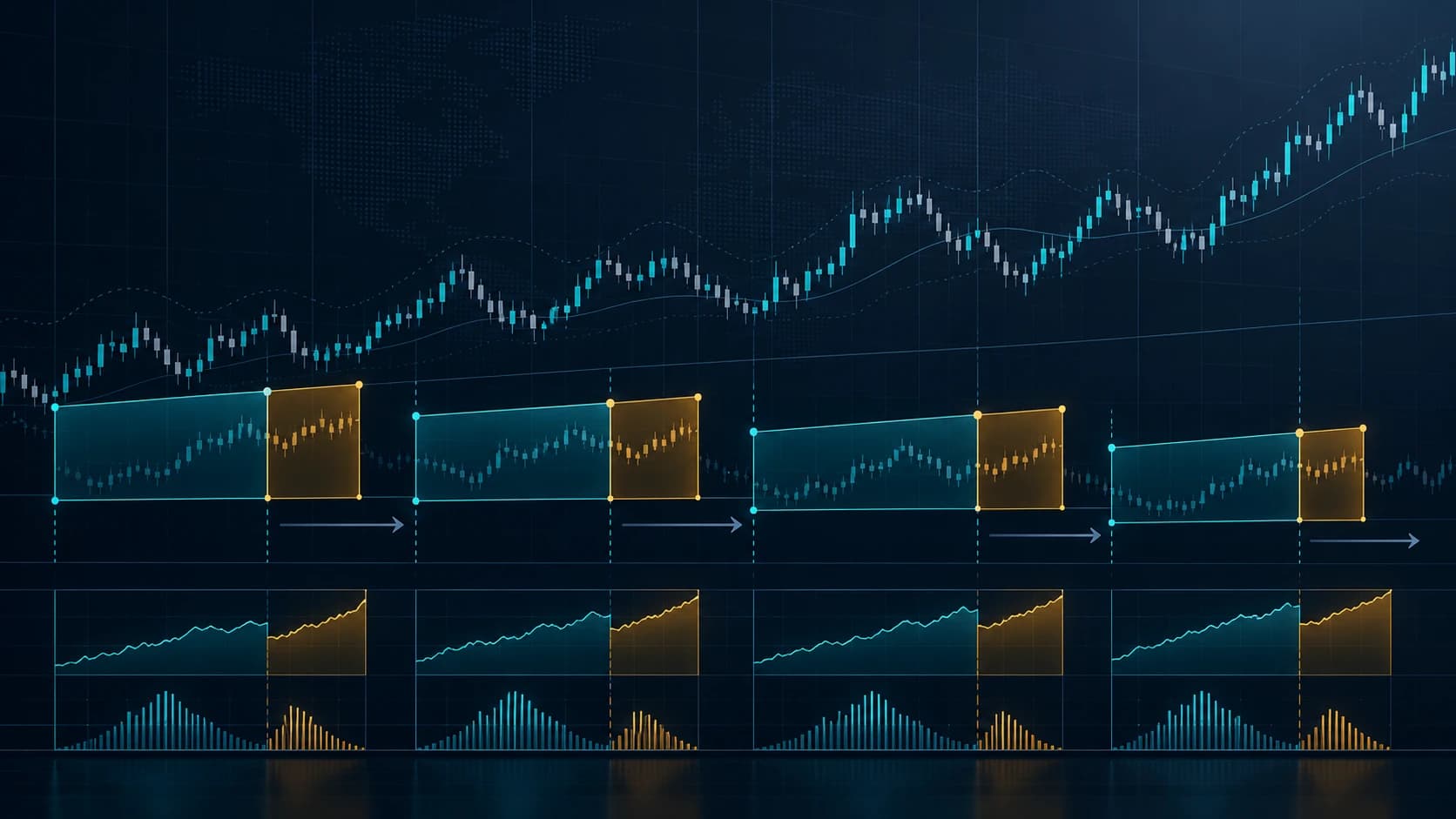
A strategy can look excellent when its parameters are chosen using the same history on which performance is reported. The test has memorised the past. Walk-forward analysis reduces this problem by repeatedly developing the rule on an earlier window and evaluating it on the next unseen window.
It does not guarantee future profit. It creates a more realistic simulation of how research decisions would have been made through time.
1. Divide history in chronological order
The first block is the in-sample window. It is used to select or estimate rules. The following block is out-of-sample and remains untouched until the rule is fixed.
For example, a researcher may use three years for development and the next six months for evaluation. After that, both windows move forward and the process repeats. The out-of-sample results from each step are joined into one continuous record.
Never shuffle financial time series randomly. Future observations must not enter the training window.
2. Choose rolling or expanding windows
A rolling window keeps a fixed length, such as the most recent three years. Old data drops out as new data enters. This can adapt to regime change but may discard useful rare events.
An expanding window begins at a fixed start date and grows through time. It uses more history but can give old regimes increasing influence.
The choice should match the strategy. A slow investment factor may need long history; a short-lived market effect may require more recent data. Test the design, but do not choose it solely because it produces the best final return.
3. Limit parameter freedom
Walk-forward testing can still overfit if hundreds of parameter combinations are tried. Prefer simple rules, broad stable parameter regions and an explicit selection method. Record every variant tested, including failures.
If a moving-average rule performs only at 47 and 193 days but fails at nearby values, the apparent precision is suspicious. Robust behaviour usually survives modest parameter changes.
4. Include real implementation limits
Each out-of-sample window needs costs, spreads, slippage, liquidity limits and point-in-time data. Parameters can be updated only at the scheduled re-optimisation date. The test should not rewrite an earlier decision after seeing later prices.
Compare the stitched result with a simple benchmark and with a rule whose parameters never change. Extra complexity must earn its place after costs.
Worked example
Suppose a daily trend strategy has two parameters: lookback length and exit speed. A ten-year history is tested as follows:
- Use years 1–3 to choose from a small predeclared parameter grid.
- Freeze the chosen rule and trade it hypothetically during the first six-month out-of-sample window.
- Roll both windows forward by six months.
- Repeat until the end of year 10.
- Join only the out-of-sample segments and calculate return, drawdown, turnover and R-expectancy.
The in-sample runs average +0.35R per trade, while the stitched out-of-sample record produces +0.08R after costs with a deeper drawdown. The weaker result is more informative because it reflects unseen data. If performance depends on one short window, the edge is not stable enough to claim.
These figures are hypothetical and illustrate the process, not expected returns.
Common mistakes
- Reporting the in-sample curve as strategy evidence.
- Randomly shuffling time-series observations.
- Trying many windows and publishing only the winner.
- Changing parameters inside an out-of-sample period.
- Omitting failed variants, costs or delisted securities.
- Treating one favourable walk-forward run as proof of an edge.
Practical checklist
- Is the timeline strictly chronological?
- What information is allowed in each training window?
- Is the out-of-sample block untouched until rules are frozen?
- Are rolling or expanding windows justified by the strategy?
- How many parameter combinations were attempted?
- Are costs and point-in-time data included?
- Is the final record made only from unseen segments?
- Does the result beat a simpler fixed rule and benchmark?
The Money Man view
Walk-forward testing is a discipline for honest sequencing. It exposes the difference between finding a pattern and operating it through changing conditions. We value stable, modest out-of-sample behaviour more than a spectacular in-sample curve and treat deterioration as information rather than something to optimise away.
Educational information only. This tutorial is AI-assisted and published by The Money Man. It is not personalised investment advice, a recommendation or a promise of returns. Backtests are hypothetical and trading can result in losses.