Nikkei Closes Below 63,000 as KOSPI Reclaims Support and Gold Rebounds
Last saved:
Executive Summary
- ✦Nikkei closed near its session low at about 62,908, confirming the break below 63,000.
- ✦KOSPI briefly broke 5,493 but recovered roughly 48 points from its low to close near 5,534.
- ✦Gold reversed from about $4,082 to $4,110, invalidating the immediate sub-$4,095 breakdown.
- ✦Nasdaq futures remained near 29,500, Brent held above $111 and Bitcoin set a lower session low near $82,366.
Nikkei Closes Below 63,000 as KOSPI Reclaims Support and Gold Rebounds
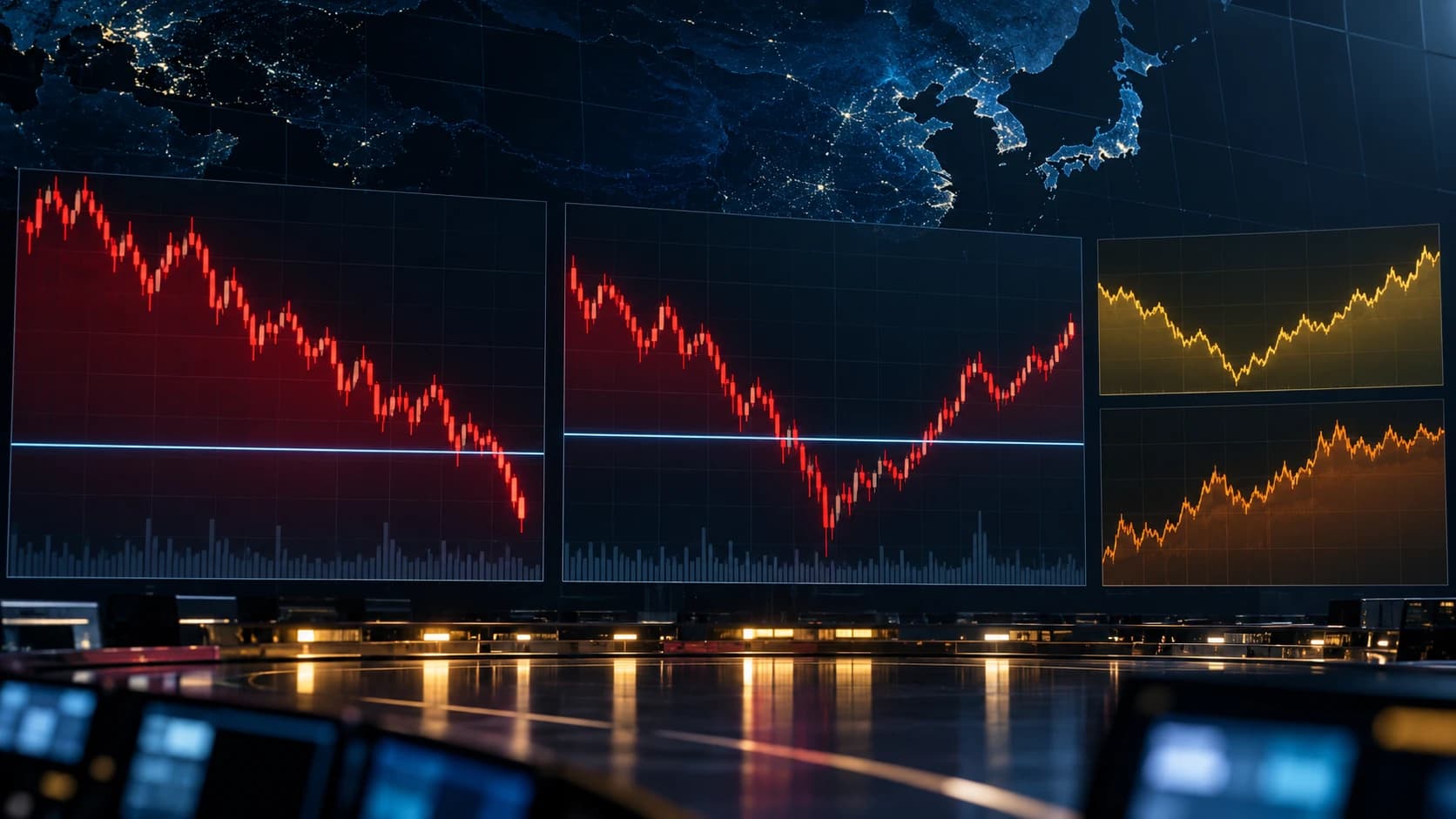
Japan and South Korea produced different closing signals after a technology-led Asian sell-off. The Nikkei 225 finished near its session low and below 63,000, while KOSPI briefly broke the 5,493 support area before recovering more than 45 points into the close. Gold also reversed back above $4,100, although Nasdaq futures remained near 29,500 and Brent stayed above $111.
This updates our earlier breakdown analysis. The important new information is closing confirmation in Japan, a failed intraday break in South Korea and a cross-asset reversal in gold.
Market snapshot: Asian cash closes and indicative futures sampled between 06:00 and 07:02 UTC on 22 October 2026 (07:00–08:02 UK time; 12:00–13:02 Bangladesh time). Hong Kong was still trading. US index, gold and oil figures were futures. Quotes may be delayed and can change rapidly.
Nikkei confirms the break below 63,000
Nikkei 225 closed near 62,908, down approximately 2.65% from Wednesday's 64,621.24 close. The closing print was also the observed session low, which gives the break below 63,000 more weight than a brief intraday move.
SoftBank Group closed near 4,305 yen, down roughly 6.9% and at its session low. The Associated Press reported earlier losses in SoftBank, Tokyo Electron and Advantest as concerns about the cost of financing data-centre construction weighed on large technology names.
On the daily timeframe, the first downside reference is around 62,650, followed by 62,300–62,400. A recovery above 63,208 would be the first sign that the close was a false break; 63,503 remains the stronger invalidation level.
KOSPI rejects its intraday breakdown
KOSPI fell as low as approximately 5,486, breaking the 5,493 support boundary intraday, but recovered to close near 5,534. The index still lost about 3.52%, yet the 48-point rebound from the low means sellers did not retain control of the broken level into the close.
Samsung Electronics closed near 214,500 won, down about 4.0%, after touching 212,000. SK Hynix finished near 1,223,000 won, down roughly 5.5%, after an intraday low of 1,204,000. Both shares remained weak, but their recovery from the lows helped KOSPI reclaim support.
This is a failed intraday break, not a bullish reversal by itself. A daily recovery above 5,553, followed by 5,590, would strengthen the stabilisation case. A future close below 5,486 would reopen the 5,451 area.
Hang Seng remains below 23,000
Hong Kong was still trading at the snapshot. Hang Seng was near 22,920, down approximately 3.09% from the verified 23,651.87 previous close, after an observed afternoon low around 22,889.
The index remained below 23,000 despite KOSPI's late recovery. A reclaim of 23,000 would be the first stabilisation signal, while 23,221 remains the stronger invalidation level. Below 22,889, the next area to monitor is 22,750–22,800.
Gold reverses while Nasdaq futures remain weak
Gold futures rebounded from approximately $4,082 to $4,110 per troy ounce. The recovery above $4,100 invalidated the immediate sub-$4,095 breakdown, but gold remained about 0.96% below the $4,150 previous reference.
The next recovery test is $4,119–$4,123. Holding above $4,100 would support a stabilisation view; a renewed break below $4,082 would expose $4,065–$4,075.
Nasdaq 100 futures traded near 29,525, down about 1.61% from the 30,007 reference, after reaching approximately 29,500. S&P 500 futures were near 7,733, down about 0.87%, and Dow futures near 52,810, down about 0.47%.
The Nasdaq contract has stopped just above the broader 29,392–29,226 support zone. A move back above 29,583 would show early stabilisation. Below 29,500, 29,392 becomes the next decision level.
Brent holds above $111 while Bitcoin sets a lower low
December Brent futures traded near $111.30, up about 2.28%, after reaching approximately $111.77. The contract tested but did not break the recent $111.97 high. A sustained move above $111.97 would strengthen the inflation and energy-cost signal; a drop below $110.59 would weaken the breakout.
Bitcoin traded near $82,408, down approximately 1.92% from the $84,024 reference, after reaching a new session low near $82,366. Unlike KOSPI and gold, Bitcoin had not produced a convincing rebound at the snapshot. A recovery above $82,825 would reduce immediate pressure; below $82,366, the $82,000 area becomes the next reference.
Scenarios for the European and US sessions
Risk selling extends
This scenario strengthens if Nasdaq futures break 29,500 and 29,392, Hang Seng closes below 22,889 and Bitcoin loses $82,366. Brent above $111.97 would add pressure through energy and inflation expectations.
Invalidation: Nasdaq futures above 29,583, Hang Seng above 23,000 and Bitcoin above $82,825, especially if gold holds above $4,100.
Asian failed breaks lead to stabilisation
KOSPI's recovery and gold's rebound can become a broader stabilisation signal if Nasdaq futures reclaim 29,583–29,675, Hang Seng returns above 23,000 and Bitcoin recovers $82,825.
Invalidation: fresh lows in Nasdaq futures, Hang Seng and Bitcoin while Nikkei futures remain below the cash close.
Cross-asset divergence persists
Equities may remain weak while oil stays high and gold recovers. This would signal a mix of technology valuation pressure, energy risk and defensive demand rather than indiscriminate liquidation. Brent below $110.59 or gold below $4,082 would weaken that interpretation.
The Money Man View
The Asian closes argue against treating every market as one trade. Japan confirmed a bearish daily break, South Korea rejected its first break below support, and gold reversed a bearish intraday move. Hang Seng and Nasdaq futures remained weak, so the broader risk signal has not disappeared.
For daily-timeframe traders, Nikkei's close below 63,000 is the clearest bearish evidence. KOSPI needs another close to show whether 5,493 is genuine support or only a temporary pause. For intraday traders, Nasdaq 29,500–29,583 and Hang Seng 22,889–23,000 are the nearest decision ranges.
Waiting for a retest can reduce the risk of selling a low or buying a single rebound candle. Position size should allow for wider volatility while technology indices and oil remain near major levels.
What to monitor next
- Nikkei futures relative to the 62,908 cash close and 63,208 recovery level.
- KOSPI 5,486–5,553 after its failed intraday breakdown.
- Hang Seng at 22,889 and 23,000 into the close.
- Nasdaq futures at 29,500, 29,392 and 29,583.
- Gold at $4,100–$4,123 after its rebound.
- Brent at $111.97 and Bitcoin at $82,366.
Sources and methodology
Regional context and earlier technology-sector moves were corroborated with the Associated Press Asia market report. Bank of Korea policy context was checked against the updated Reuters decision report. Prices and session ranges were sampled from Yahoo Finance chart data for the Nikkei 225, KOSPI, Hang Seng, Nasdaq 100 futures, Brent, gold and Bitcoin.
This market analysis was prepared with AI-assisted research and editorial review. It is educational information, not personalised investment advice. Futures, equities, commodities and cryptocurrency can reverse sharply, and no scenario guarantees a return.